Olympia
The ruins of Olympia in Greece testify to the importance of the site of the Olympic Games, a symbol of ancient Greece, bringing together all Greek peoples during a sacred truce.
Olympia, sanctuary of Zeus and birthplace of the Olympic Games
In a verdant valley of Elis, at the confluence of the Alpheus and Kladeos, Olympia was for more than a millennium one of the great Panhellenic sanctuaries of the Greek world. This vast religious and athletic centre dedicated mainly to Zeus hosted the Olympic Games every four years. Its temples, sports facilities and honorific monuments now form a vast archaeological site inscribed on the UNESCO World Heritage List.
The archaeological site and its museums easily warrant half a day to a full day. The modern village of Ancient Olympia lies just beside it and serves as a base. The setting of the valley, at the foot of Mount Kronion, among pines, olive trees and streams, contributes greatly to the site's appeal.
The sanctuary of Olympia and the birth of the Games
The origins of the Games are intertwined with several mythological traditions. According to one of them, Heracles organized the first competitions in honour of Zeus and marked out the sacred enclosure of the Altis. Another tradition attributed their founding to Pelops, after his victory in the chariot race against King Oenomaus.
The first Olympiad recorded by historical tradition dates to 776 BC. Ancient sources also associate Iphitos, king of Elis, Lycurgus of Sparta and Cleisthenes of Pisa with the reorganization of the Games and with the ekecheiria, the sacred truce guaranteeing in particular the movement of participants.
Athletes competed in foot races, wrestling, boxing, pankration and the pentathlon, while horse and chariot races took place in the hippodrome, which has now disappeared. The festivities also included processions, sacrifices and religious ceremonies. The victors received the kotinos, a crown of wild olive.
The Altis, sacred heart of Olympia
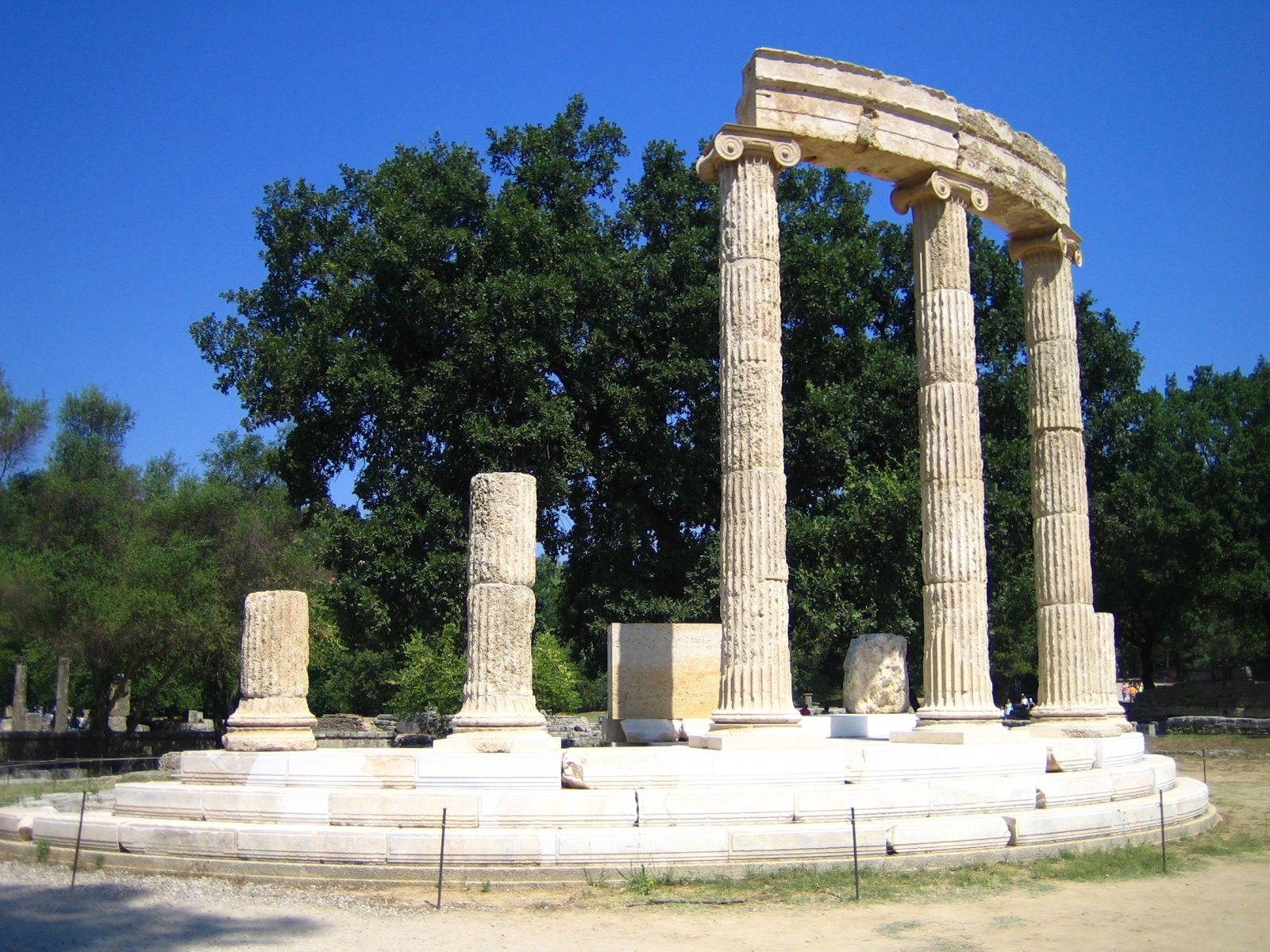
Temple of Philip II (Philippeion) (via Wikimedia Commons)
The visit is organized around the Altis, the sacred grove containing the main religious monuments. The most imposing was the Temple of Zeus, a large Doric building of the 5th century BC. Its pediments and metopes were decorated with vast sculptural compositions dedicated in particular to Pelops, the Centaurs and the Labours of Heracles.
In its cella stood the gigantic chryselephantine statue of Zeus made by Phidias around 430 BC. More than twelve metres high, it was counted among the Seven Wonders of the Ancient World. The statue has disappeared, but the remains of the workshop of Phidias can still be seen nearby.
The Temple of Hera, built around 600 BC, is older. It is near its altar that the flame for the modern Games is now lit. Around it are the Pelopion, the circular Philippeion erected by Philip II of Macedon and several treasuries built by different Greek cities.
The stadium and the athletes' facilities
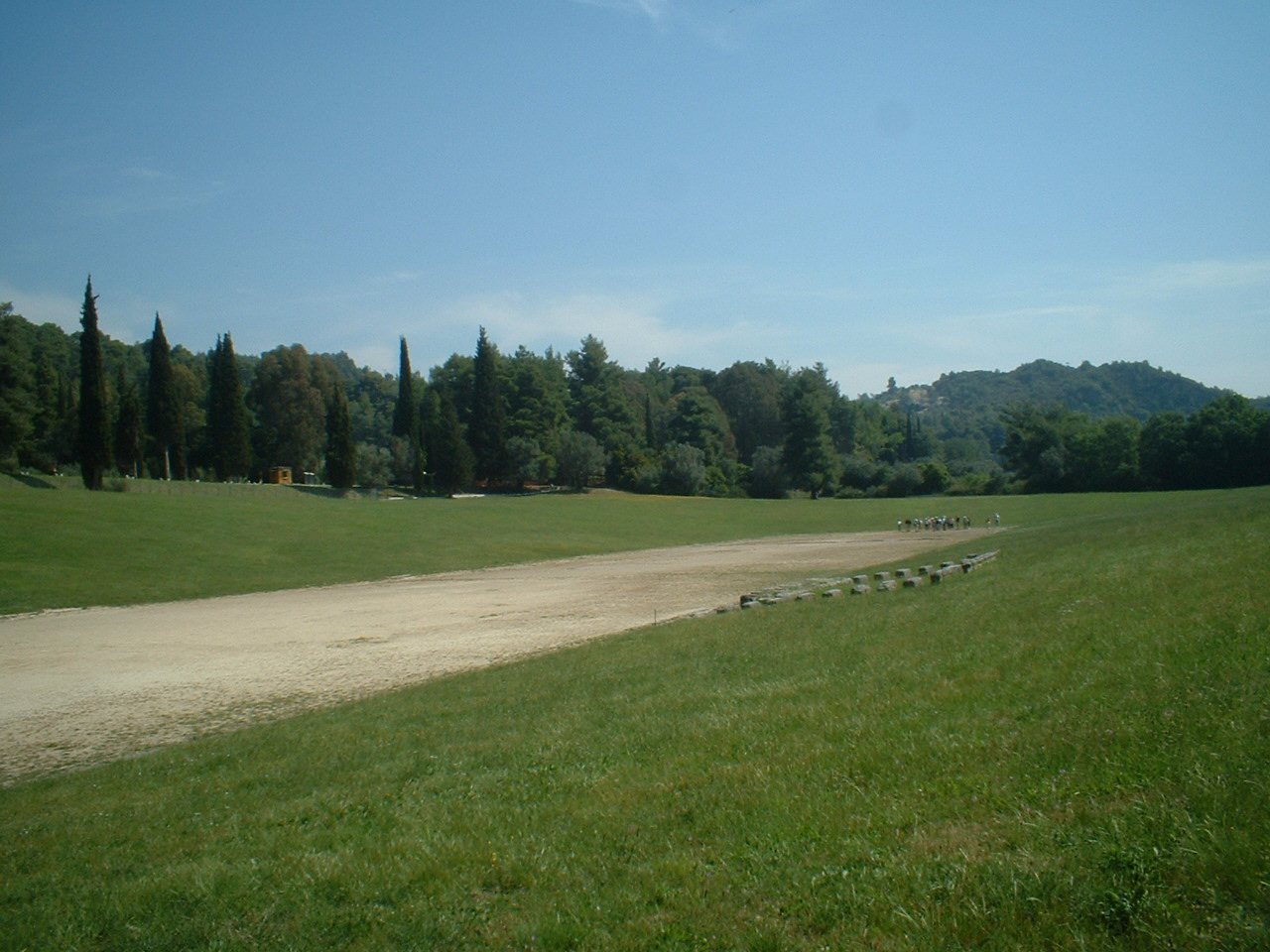
A vaulted passage leads to the ancient stadium, whose earthen track measures about 192 metres. Spectators took their places on the surrounding embankments, without monumental stands.
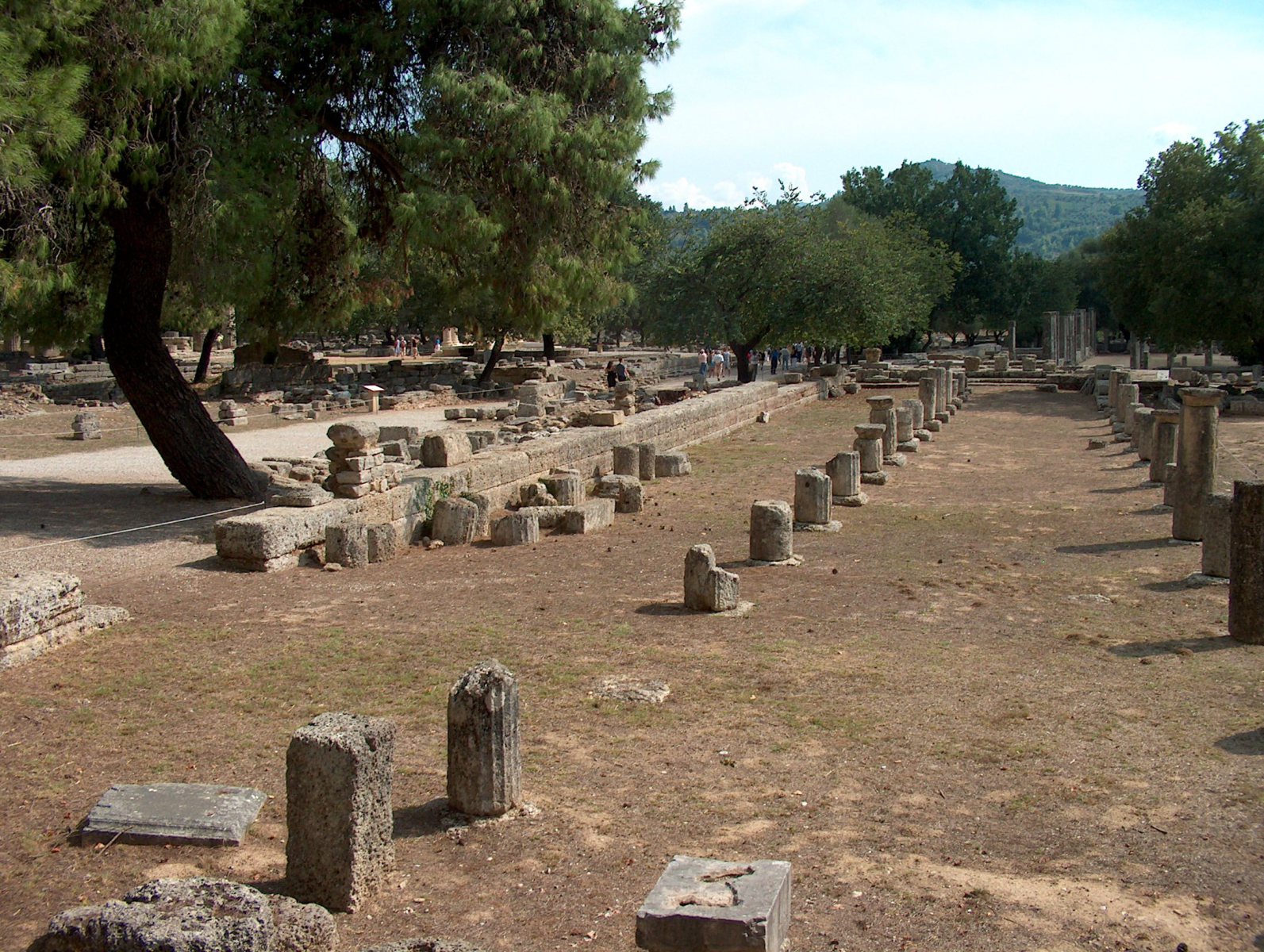
East portico of the gymnasium (Guenter Wieschendahl, via Wikimedia Commons)

To the west of the Altis survive the remains of the gymnasium and the palaestra, used for training. The bouleuterion served for the administration of the Games, while the Prytaneion housed the victors in particular. The vast Leonidaion was intended to accommodate official visitors.
Olympia was therefore much more than a stadium: the sanctuary combined religion, sport, administration and political display, while votive monuments allowed Greek cities to display their prestige.
The Archaeological Museum of Olympia
The Archaeological Museum, located near the site, preserves a large part of the original decoration of the monuments. There one can discover in particular the sculptures from the pediments of the Temple of Zeus, its metopes dedicated to the Labours of Heracles and the spectacular Nike of Paionios.
Among the other major works is Hermes Carrying the Infant Dionysus, traditionally attributed to Praxiteles and found in the Temple of Hera. The collections also include numerous bronzes and votive offerings as well as the terracotta group representing Zeus Abducting Ganymede.
The neighbouring Museum of the History of the Ancient Olympic Games completes the visit by presenting the origin of the contests, the different events, the rules and the evolution of the Games in antiquity.
Stadium of Olympia (via Wikimedia Commons)
Sources: UNESCO – Archaeological Site of Olympia ; Greek Ministry of Culture – Archaeological Site of Olympia ; Greek Ministry of Culture – Visit to the Sanctuary of Olympia ; Greek Ministry of Culture – Archaeological Museum of Olympia ; Greek Ministry of Culture – Museum of the History of the Olympic Games.
Map and route
Nearby places to stay
On the same theme