
Patras
Patras, Greece's third-largest city and the capital of Achaea, a major port on the Gulf of Patras with links to Italy and the Ionian Islands, known for its old town, its citadel and its carnival.
Patras, a major port city and the western gateway to the Peloponnese
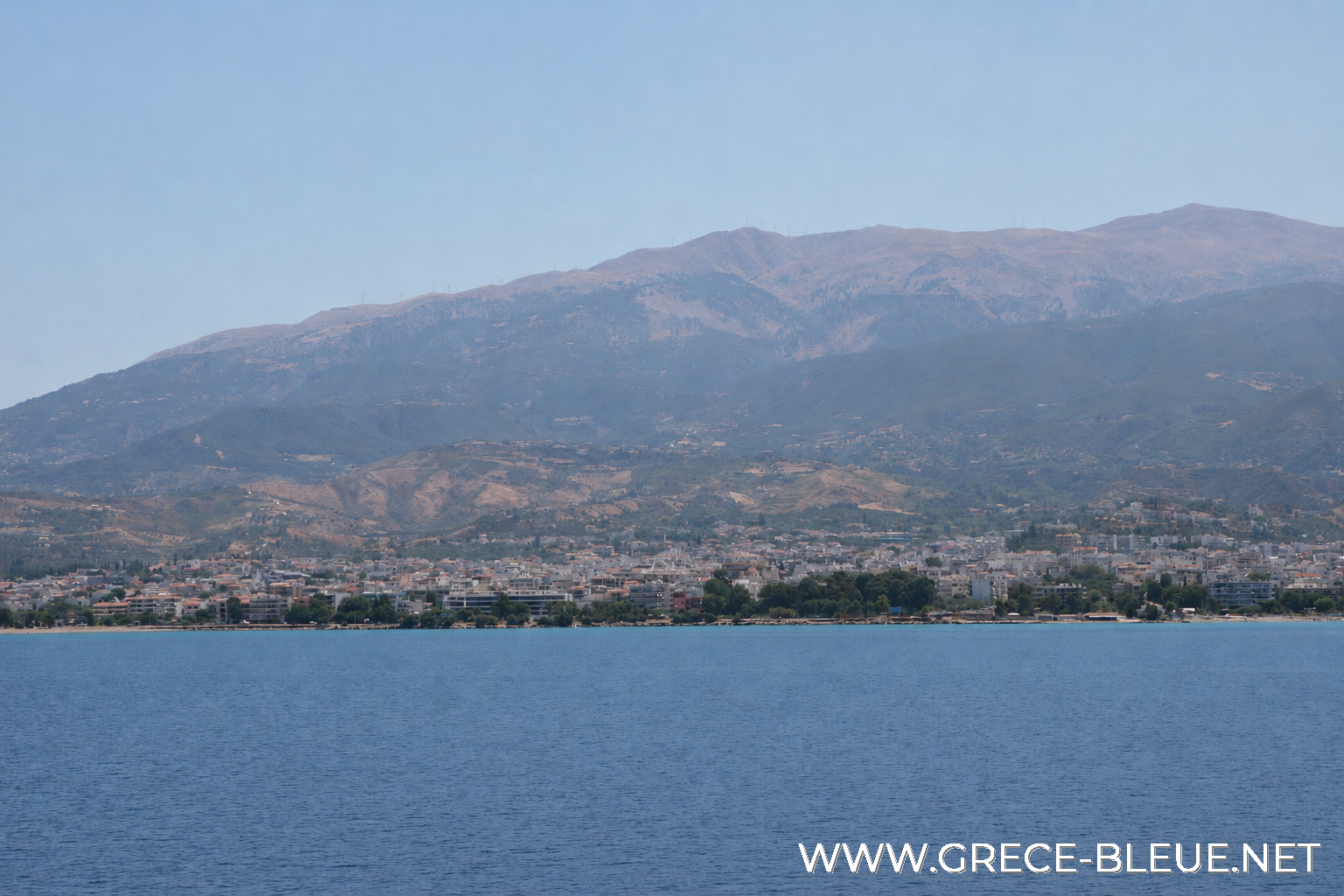
View of Patras from the sea
At the northwestern tip of the Peloponnese, Patras is the main city of Achaea and the third-largest city in Greece. Stretching between the slopes of Panachaiko and the Gulf of Patras, it has owed much of its importance since antiquity to its port, which is still one of Greece's main maritime gateways to Italy and Western Europe. Less immediately charming than Nafplio, it nevertheless has an ancient, Byzantine and neoclassical heritage rich enough to justify a real stop.
From Roman Patras to the modern city
Inhabited since prehistoric times, Patras experienced particular prosperity under the Roman Empire. Augustus made it a Roman colony at the end of the 1st century BC, and its position on the sea routes linking Greece to Italy fostered its development. The city then acquired major public facilities: a stadium, an odeon, baths, an aqueduct, bridges and port installations.
According to Christian tradition, the apostle Saint Andrew preached in Patras and suffered martyrdom there in the 1st century. Having become an important Christian centre, the city then passed under Byzantine, Frankish, Venetian and later Ottoman rule. It was almost entirely devastated during the fighting of the 1821 War of Independence and liberated in 1828. From 1829, a new urban plan drawn up by Stamatis Voulgaris organised its reconstruction around straight streets and large squares.
Roman Odeon and remains of the ancient city
The main ancient monument is the Great Roman Odeon★, built in the first half of the 2nd century AD on the slopes of the upper town. Pausanias praised the richness of its decoration. Restored, it retains its tiers of seats, its orchestra and its imposing stage wall and can now accommodate more than 2,000 spectators during cultural events.
Nearby, the remains of the Roman stadium are gradually emerging, a vast structure about 200 metres long built at the end of the 1st century AD. Other traces of the Roman city are scattered throughout Patras, including sections of roads, necropolises and the aqueduct attributed to the reign of Hadrian, which brought water to the acropolis over several kilometres.
The castle and the upper town
Above the centre stands the castle of Patras★, built in the 6th century under Justinian on the site of the ancient acropolis. Franks, Byzantines, Venetians and Ottomans successively occupied and altered it. Its walls and its tree-planted enclosure now dominate the city and the gulf and offer one of the best panoramas of Patras.
The upper town that surrounds it retains more character than some modern areas of the centre: monumental stairways, narrow streets, old mansions and churches follow one another. On the way back down, the large squares and pedestrian streets of the lower town recall the neoclassical plan adopted after independence. Georgiou Square is notably dominated by the Apollo Theatre, an elegant neoclassical building inaugurated in 1872.
Saint Andrew and religious heritage
Near the seafront stand the two churches dedicated to Saint Andrew. The old basilica was built between 1836 and 1843, while the huge modern church next to it★, begun in 1908 and inaugurated in 1974, has become one of Greece's major Orthodox pilgrimage sites. They occupy the area traditionally associated with the apostle's martyrdom and preserve relics attributed to him.
The Archaeological Museum of Patras
The Archaeological Museum of Patras★ is one of the most interesting visits in the city. Its collections cover the history of Patras and western Achaea from Prehistory to the end of Antiquity. They are particularly rich for the Roman period, with sculptures, funerary objects and above all remarkable mosaics from Roman villas, decorated with mythological scenes and figurative motifs.
Patras and its surroundings
To the north-east of the city, the spectacular Rio-Antirrio Bridge★, inaugurated in 2004, crosses the Gulf of Corinth and directly links the Peloponnese to central Greece. At Rio there also survives a fortress built at the end of the 15th century to control this strategic passage.
A few kilometres from the centre, the archaeological site of Voundeni preserves an important settlement and a vast Mycenaean necropolis. Patras is also a good base for continuing towards the mountains of Kalavryta★ and the Vouraikos Gorge or, to the south, reaching Elis and Olympia★★. The city itself can easily be visited in a single day, or longer if you wish to enjoy its museum, its urban life and its surroundings.