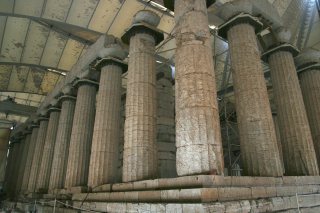
Ancient Messene
At the foot of Mount Ithome, in a vast fertile valley of Messenia, Ancient Messene is one of the most remarkable archaeological sites in the Peloponnese. Theatre, sanctuaries, agora, stadium, gymnasium, funerary monuments and powerful fortifications make up an exceptionally legible ancient city, largely cleared and restored.
With its size, its natural setting and the quality of conservation of its monuments, Ancient Messene is worth several hours of visiting. From the theatre and the Asclepieion to the Arcadian Gate, the ensembles are varied and allow you to explore almost all the components of a great Greek city, from places of worship and power to sports facilities, residential districts, funerary monuments and fortifications.
It also has the rare advantage of not having been covered by a significant modern settlement.
The capital of the Messenians freed from Sparta
The city was founded in 369 BC by the Theban general Epaminondas, two years after his victory over Sparta at Leuctra. After several centuries of Spartan domination, it became the capital of the new Messenian state and the symbol of its regained independence. The city took the name of Messene, the mythical queen to whom the Messenians traced their ancient traditions.
Messene was organised according to a Hippodamian plan, with a regular grid of streets, residential districts and vast public spaces. It experienced significant prosperity especially in the Hellenistic and Roman periods. After the destructions caused by the Goths in the 4th century AD, a new urban centre, which became an episcopal seat, developed on the site during the Early Byzantine period.
Theatre, agora and sanctuary of Asclepius
Near the entrance to the site stands the vast theatre, built in the 3rd century BC and remaining in use until the 4th century AD. It hosted both performances and political assemblies and was profoundly transformed in the Roman period, notably with the construction of an imposing stone stage building.
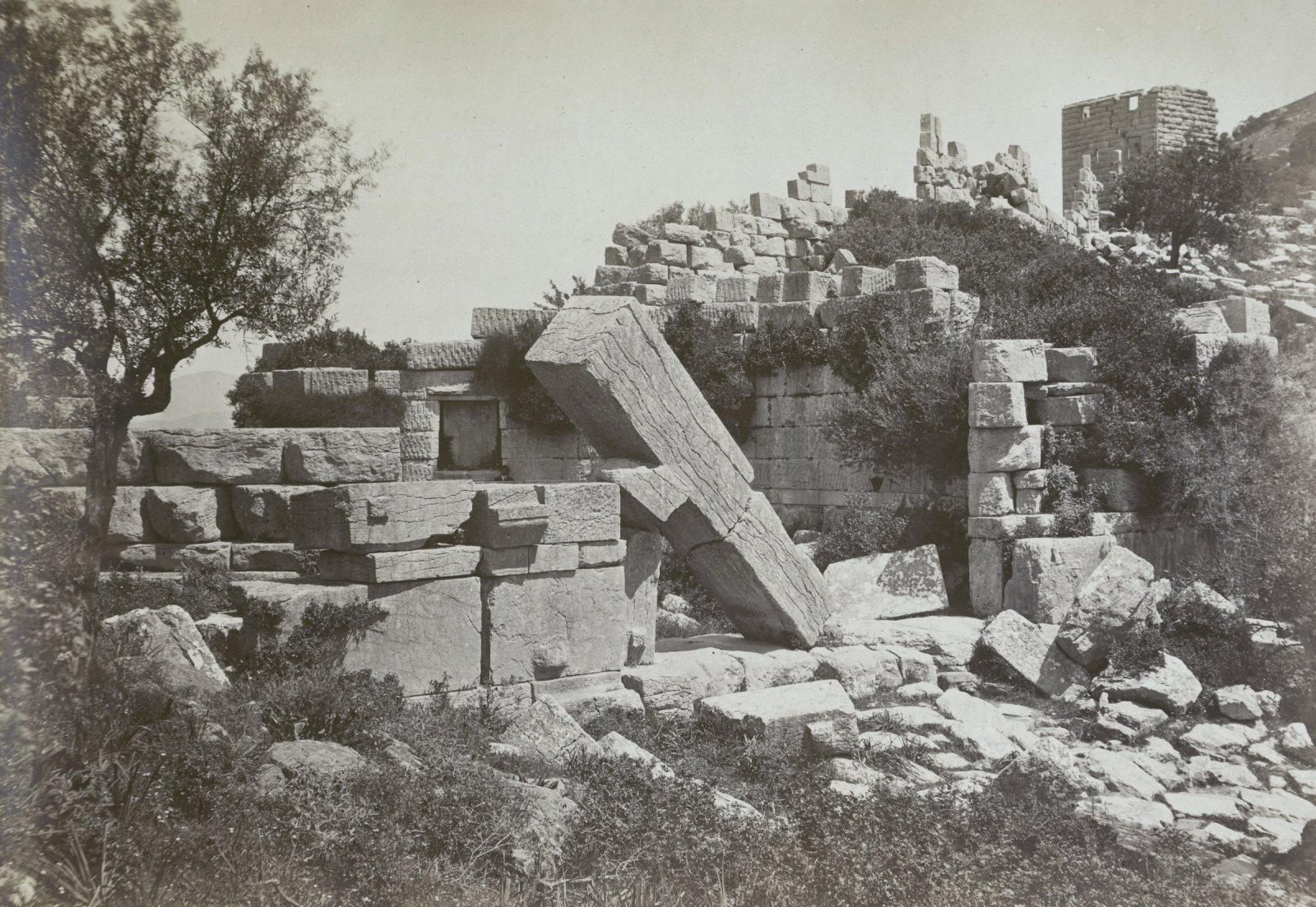
Arcadian Gate, Messene (1869)
Below stretched the agora, the vast political, economic and religious centre of the city, lined with porticoes and neighbouring the monumental Arsinoe Fountain. It contained in particular administrative buildings, the Prytaneion, sanctuaries and a temple dedicated to the mythical queen Messene.
Nearby, the Asclepieion★★, laid out in its monumental form around 215-214 BC, constitutes one of the major ensembles of the site. Around the Doric temple of Asclepius were distributed porticoes, cult rooms and civic buildings, including the Ecclesiasterion and the Bouleuterion. Unlike that of Epidaurus, the Asclepieion of Messene was not primarily a healing centre: it also played a major religious, political and identity role.
Several sanctuaries housed monumental sculptures by the Messenian Damophon, one of the great artists of the Hellenistic period. Artemis, Demeter, Zeus, Poseidon, Aphrodite, Isis and other deities were also honoured in a city particularly rich in places of worship.
The stadium, the fortifications and the Arcadian Gate
In the lower part of the site stretches one of its most spectacular ensembles: the stadium and gymnasium★★, surrounded by long Doric colonnades. The palaestra, the training facilities, the statues of gods, heroes and benefactors as well as several funerary monuments allow us to reconstruct the sporting, educational and social role of this vast complex.
Messene was protected by approximately 9.5 km of walls, reinforced with towers and enclosing not only the city but also Mount Ithome. Their most famous remnant is the Arcadian Gate★★, which opened the road towards Megalopolis. Two passages frame an impressive circular courtyard once protected by powerful towers.
Above the city, Mount Ithome formed its natural acropolis and its main sacred landscape. At the summit, at an altitude of about 800 metres, stood the sanctuary of Zeus Ithomatas, whose cult is attested as early as the 8th century BC, well before the founding of the classical city.
Museum and visit of Ancient Messene
The Archaeological Museum of Ancient Messene, immediately next to the site, brings together sculptures and objects from the excavations. Among its main pieces are statues of Hermes, Artemis and Isis as well as several works by Damophon, which allow visitors to rediscover part of the rich sculpted decoration of the sanctuaries.
Sources
- Ephorate of Antiquities of Messenia – Ancient Messene
- Ephorate of Antiquities of Messenia – Theatre of Ancient Messene
- Ephorate of Antiquities of Messenia – Asklepieion
- Ephorate of Antiquities of Messenia – Gymnasium and stadium
- Ephorate of Antiquities of Messenia – Fortifications and Arcadian Gate
- Ephorate of Antiquities of Messenia – Archaeological Museum
- UNESCO – Archaeological Site of Ancient Messene