Messinia
Messinia brings together several of the Peloponnese's major attractions: important archaeological sites, coastal fortresses, historic towns and villages, beaches and mountain landscapes. Ancient Messene, Pylos and the Palace of Nestor, Methoni and Koroni, then Kalamata and the Messinian Mani are the main hubs.
Messenia, ancient cities, fortresses and beaches of the south-west Peloponnese
In the south-west Peloponnese, Messenia combines a vast agricultural plain covered with olive trees, the slopes of the Taygetus, long coastlines open to the Ionian Sea and the Gulf of Messenia. Its heritage is particularly varied: Mycenaean palace, great ancient city, Frankish and Venetian fortresses, port towns and villages of the Mani follow one another through landscapes that are often less built-up than those of the north-east Peloponnese.
Kalamata★, the region's main town, stretches at the head of the Gulf of Messenia, between the coastline and the first foothills of the Taygetus. Its historic centre preserves a medieval castle, several churches and old houses, while the Archaeological Museum of Messenia traces the region's history from Prehistory to the Byzantine period. The town is also a convenient base for reaching Messene as well as the Mani or the western coasts.
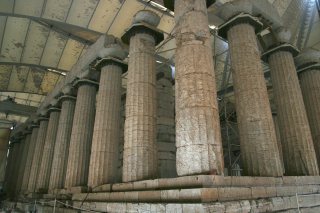
In the mountains of north-east Messenia, on the historic borders of Arcadia, the Temple of Apollo Epicurius at Bassae★★, a UNESCO World Heritage Site, is one of the most remarkable classical monuments of the Peloponnese.
From ancient Messene to the Mycenaean kingdom of Pylos
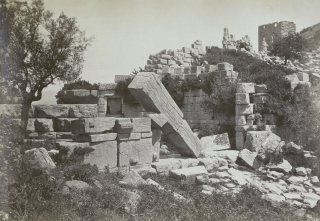
About thirty kilometres from Kalamata, ancient Messene★★ is one of the great archaeological sites of the Peloponnese. Founded in the 4th century BC after the liberation of the Messenians from Spartan rule, the city spreads at the foot of Mount Ithome. Its vast complex includes in particular a theatre, agora, Asclepieion, stadium, gymnasium, sanctuaries and powerful fortifications, including the monumental Arcadian Gate.
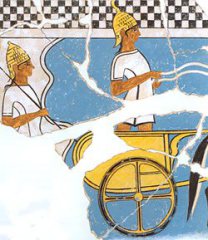
Further west, the region of Pylos recalls a much older history. Near Chora, the Palace of Nestor★ at Ano Englianos is one of the main Mycenaean palatial centres known in Greece. Linear B tablets found there have documented in particular the administration and economy of the kingdom in the 13th century BC.
Pylos, Methoni and Koroni: fortresses facing the sea
The small town of Pylos★ overlooks the vast Bay of Navarino, protected by the island of Sphacteria. Its Niokastro, an Ottoman fortress transformed over the centuries, recalls the strategic importance of this roadstead, where the naval Battle of Navarino in 1827 played a decisive role in the Greek War of Independence.
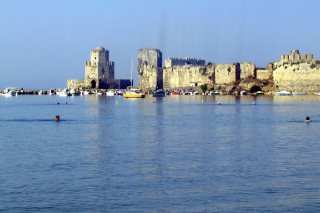
Further south, Methoni and Koroni★ are among the great fortified complexes of the Peloponnesian coast. Long controlled by Venice and located on the maritime routes between the Adriatic and the eastern Mediterranean, the two strongholds were nicknamed the "eyes of Venice". Methoni impresses with its vast enceinte extended into the sea by the small Bourtzi fort, while Koroni combines a fortress, an old town and views over the Gulf of Messenia.Voidokilia, the Messenian Mani and natural landscapes
Around Pylos are also some of the most remarkable coastal landscapes of the Peloponnese. The almost circular beach of Voidokilia★ borders the protected lagoon of Gialova, dominated by the Palaiokastro promontory. Further south, Finikounda and the coasts between Methoni and Koroni alternate long beaches, coves and small seaside resorts.
To the east of Kalamata begins the Messenian Mani, on the western slopes of the Taygetus. Kardamyli★, its stone houses and the fortified tower of the Mourtzinos family form one of its main historic centres, while Stoupa is more oriented towards its beaches; it was in its surroundings that Nikos Kazantzakis operated a mine with Giorgos Zorbas, who later inspired the character of Alexis Zorba. The Vyros gorges, which descend from the Taygetus towards Kardamyli, complete this mountainous and coastal part of Messenia.
To the northwest, the region of Kyparissia opens onto Trifylia and a wilder coastline, while the Mycenaean site of Peristeria and the Neda Gorges, on the borders of Elis, allow you to extend your exploration inland. Closer to Kalamata, the waterfalls and pools of Polylimnio are another popular natural excursion.
Map and places in Messinia
2 places and 3 zones in this territory.
 1
Archaeological site
Ancient Messene
At the foot of Mount Ithome, in a vast fertile valley of Messenia, Ancient Messene is one of the most remarkable archaeological si…
 2
Archaeological site
Phigalia and Bassae
The Doric Temple of Apollo Epikourios, built at an altitude of over 1000 metres in an isolated site in the Peloponnese, exceptiona…
 3
Territoire
Kalamata and the Messenian Mani
 4
Ville
Methoni and Koroni
Methoni impresses more through the monumentality and preservation of its immense fortress, while Koroni charms through the continu…
 5
Ville
Pylos