Pylos
Pylos combines within a short distance Mycenaean archaeology, fortresses, modern history, boat trips and beaches.
Pylos, Palace of Nestor and Navarino Bay
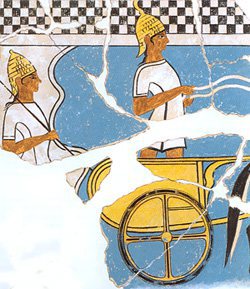
Two helmeted warriors and a chariot on a fresco from the Palace of Nestor (around 1350 BC), via Wikimedia Commons
On the western coast of Messenia, Pylos occupies one of the finest natural harbours in the Peloponnese, Navarino Bay, almost entirely sheltered from the Ionian Sea by the long island of Sphacteria. The region combines remarkable coastal landscapes with several major stages of Greek history: the Mycenaean kingdom of Pylos, the Peloponnesian War, medieval and Ottoman fortresses, and then the naval Battle of Navarino in 1827.
The Palace of Nestor and Mycenaean Pylos
About 17 km north of the present-day town, on the hill of Ano Englianos, the Palace of Nestor★ is the best-preserved Mycenaean palace in Greece. It was the centre of a powerful kingdom that reached its peak in the 14th and 13th centuries BC, before the complex was destroyed by fire towards the end of the Bronze Age.
Now protected by a vast roof, the palace can be read particularly clearly from the walkways overlooking its remains. Its heart was organised around a megaron with a throne room and a large circular hearth, surrounded by apartments, storerooms, workshops and administrative areas. A terracotta bathtub is still visible in a room traditionally interpreted as a bathroom.
The excavations have above all yielded more than a thousand Linear B tablets. These archival documents, accidentally preserved by the fire that destroyed the palace, provide information on land, herds, craftsmen, religious offerings and the administration of the kingdom. They allow a concrete approach to how a Mycenaean palatial state functioned.
Nearby survive several tholos tombs associated with the elites of Pylos. Research carried out in the area since 2015 has also renewed our knowledge of the earliest Mycenaean rulers, notably with the discovery of the rich tomb known as the "Griffin Warrior". The Archaeological Museum of Chora holds an important collection of objects from the palace and from the Mycenaean sites of Messenia.
Pylos and Navarino Bay
Present-day Pylos is a small town built in an amphitheatre at the edge of the bay. Its centre is organised around the Three Admirals' Square, shaded by plane trees and open towards the port. Cafés, terraces and the seafront promenade give the town a peaceful atmosphere, very different from the region's major archaeological sites.
Navarino Bay owes its exceptional configuration to Sphacteria, a long island that forms a natural breakwater and leaves only two passages to the sea. This strategic situation explains its military importance since Antiquity. In 425 BC, during the Peloponnesian War, Athenians and Spartans clashed there in the battles of Pylos and Sphacteria.
But the bay is above all associated with the Battle of Navarino of 20 October 1827. The British, French and Russian fleets confronted and destroyed the Ottoman-Egyptian fleet there. This victory of the powers favourable to the Greek insurgents was a major turning point in the War of Independence. Several commemorative monuments stand around the bay and on Sphacteria.
Niokastro, Palaiokastro and the landscapes of Navarino
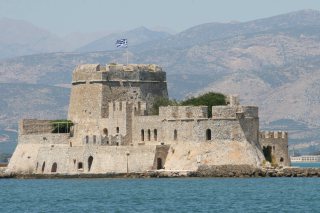
Above Pylos stands Niokastro★, or the New Fortress of Navarino, begun by the Ottomans in 1573 in order to control the southern entrance to the bay. Its ramparts, bastions and citadel offer extensive views over Sphacteria and the port. Several cultural spaces now occupy the interior of this particularly well-preserved fortress.
At the northern end of the bay, Palaiokastro instead occupies the steep promontory of Koryphasion. Built at the end of the 13th century by Nicholas II of Saint-Omer on a site fortified since Antiquity, it controlled the old entrance to the port before the construction of Niokastro. Beneath its walls lies the cave traditionally called Nestor's Cave.
The northern sector of Navarino finally concentrates several of the most beautiful landscapes in Messenia. The Gialova Lagoon, an important protected wetland, stretches behind the long Divari beach. Beyond Palaiokastro, the almost circular beach of Voidokilia★ forms one of the most famous coastal landscapes of the Peloponnese.
Sources
- Visit Peloponnese – Palace of Nestor
- Visit Peloponnese – Pylos, Navarino Bay and Sphacteria Island
- Greek Ministry of Culture – Niokastro
- Greek Ministry of Culture – Palaiokastro
- Greek Ministry of Culture – Archaeological Museum of Chora
- Visit Peloponnese – Voidokilia, Gialova and the beaches of Pylos
Map and places in Pylos
Nearby places to stay
On the same theme