Monemvassia and its surroundings
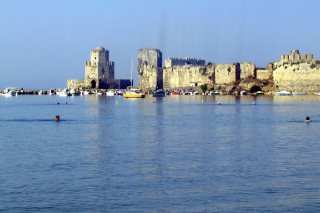
Monemvassia is a fortified town built on a rock on the eastern coast of Laconia, linked to the mainland by a causeway. Its lower town with stone-paved alleys, its ruined upper town and the neighbouring fishing villages form a singular medieval ensemble in the south-east of the Peloponnese.
Monemvasia, the fortified town of Laconia
Perched on an imposing rock on the eastern coast of Laconia, Monemvasia is one of the best-preserved and most spectacular fortified towns in the Peloponnese. The rock, linked to the mainland by a narrow causeway and a bridge, had only one access point: its name thus comes from the Greek expression moni emvasi, "single entrance".
A Byzantine fortress and a great Mediterranean port
The first fortified settlement dates back to the 6th century, when inhabitants of Laconia found refuge on this naturally protected rock. The town then developed under the Byzantine Empire and became an important commercial port between Italy, the Black Sea and the eastern Mediterranean. Its name, transformed into Malvasia in the West, was also associated with the famous Malmsey wine, widely traded throughout the Mediterranean.
Its strategic position attracted many conquerors. Taken by the Franks in 1248 after a long siege, Monemvasia returned to the Byzantines in 1262, before passing successively under Venetian and Ottoman rule. The Ottomans finally held it from 1715 until the Greek War of Independence; after several months of siege, the fortress capitulated to the Greek insurgents on 23 July 1821.
The lower town and the upper town
The lower town, still inhabited, stretches between the cliff and the ramparts. Its cobbled streets, vaulted passages, stone houses and former merchant residences form a remarkable medieval ensemble. Among the many preserved churches, Christos Elkomenos, on the main square, Panagia Chrysafitissa and Panagia Myrtidiotissa stand out. The former Ottoman mosque now houses the Monemvasia archaeological collection.
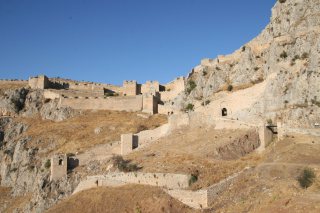
A steep winding path leads to the upper town, now uninhabited. It preserves the remains of dwellings, cisterns, baths and fortifications as well as its major monument, the church of Agia Sofia★, or Panagia Odigitria, built in the 12th century. Perched at the edge of the cliff, this octagonal church is the only building in the upper town to have come down to us in an almost complete state and offers an exceptional panorama over the Myrtoan Sea.
The historic town is entirely pedestrian. A small sea gate, the Portelo, provides direct access to the sea from the ramparts. On the mainland, facing the rock, Gefyra forms the modern town of Monemvasia and concentrates the main shops, accommodation and services.
Gerakas and ancient Zarax
About 22 km north of Monemvasia, Gerakas occupies the end of a narrow, deeply enclosed bay, often compared to a small fjord. This peaceful fishing port retains a few waterfront tavernas and makes a pleasant excursion from the fortified town.
On the hill overlooking the port survive the remains of ancient Zarax, a fortified town probably developed mainly in the Hellenistic period. Its walls are still clearly visible; Pausanias also mentioned a sanctuary of Apollo at Zarax. Monemvasia and Gerakas thus make it possible to combine, along the same stretch of the Laconian coast, Byzantine heritage, fortifications, archaeology and maritime landscapes.
Map and places in Monemvassia and its surroundings
Nearby places to stay
On the same theme