Acrocorinth
Acrocorinth is one of the most imposing fortresses in Greece, rising above ancient Corinth and the isthmus. Its walls, successive gates and ancient, Byzantine, Frankish and Ottoman remains bear witness to more than two millennia of occupation. The visit also offers vast panoramas over the Gulf of Corinth and the Saronic Gulf.
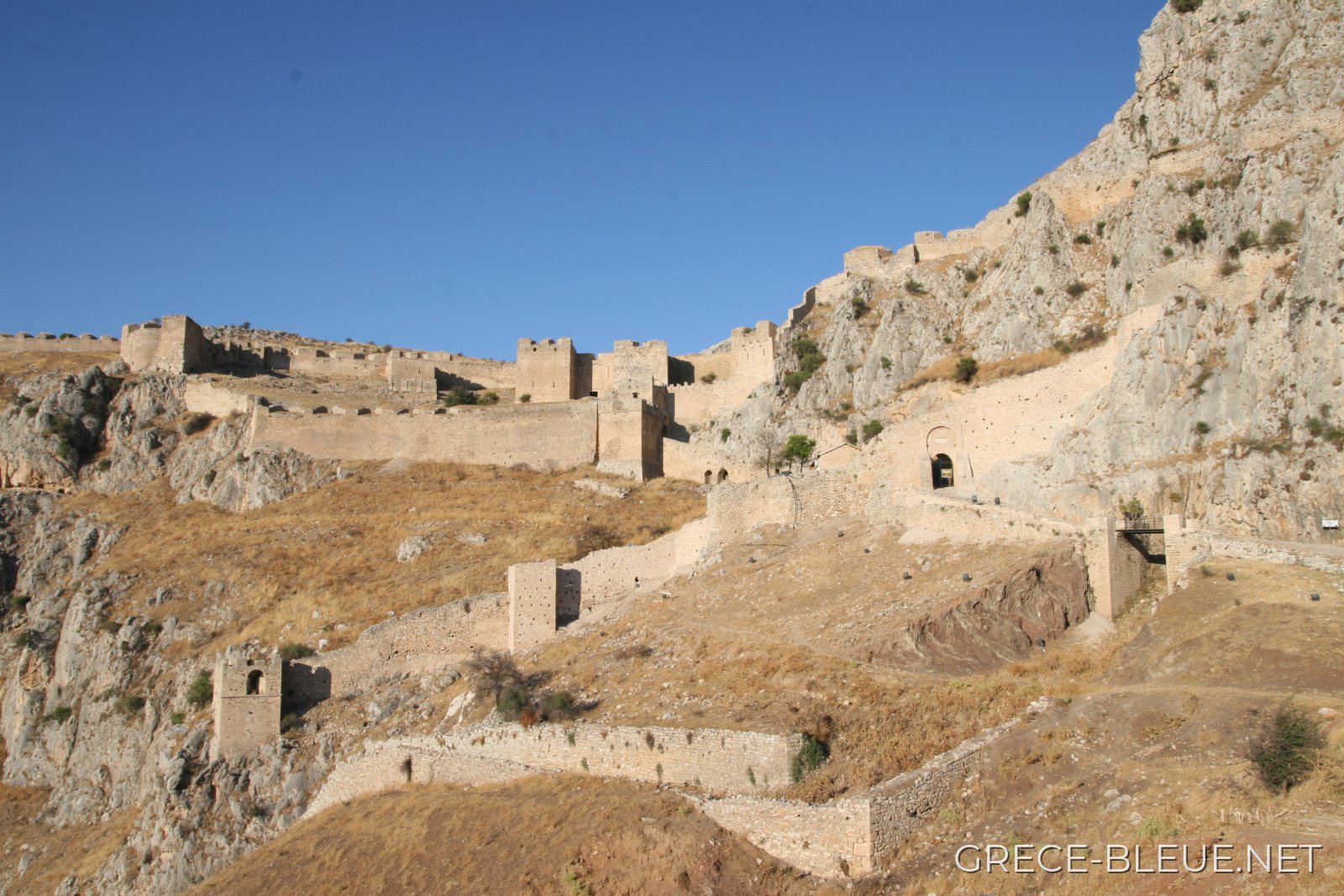
Acrocorinth, the great fortress overlooking the Isthmus of Corinth
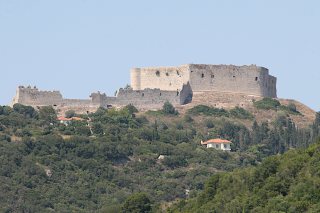
Perched on a powerful rocky spur at an altitude of about 575 metres, Acrocorinth dominates ancient Corinth and the entrance to the Peloponnese. Its position allowed it to keep watch over the isthmus, the Gulf of Corinth and, to the east, the Saronic Gulf. Used as a stronghold for more than two millennia, it now forms one of the largest and most spectacular fortified complexes in Greece.
A veritable town behind the walls
A five-year siege: from around 1205, Leo Sgouros resisted the Frankish knights in Acrocorinth. According to tradition, he finally threw himself on horseback from the top of the rocks in 1208. The resistance continued, however, and the defenders capitulated only in 1210, after five years of siege.
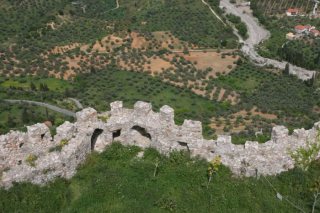
The fortress covers nearly 24 hectares and its walls follow the irregular contours of the summit for about three kilometres. The western entrance, the only relatively accessible part of the terrain, was particularly well defended: the visitor passes successively through three enclosure walls and three monumental gates★★, the result of numerous Byzantine, Frankish and later building campaigns.
Once through the gates, Acrocorinth appears less as a simple castle than as an ancient fortified town. The paths cross the remains of dwellings, cisterns, fountains, religious buildings and military structures accumulated over the centuries. On the south-western summit stands the citadel traditionally called the Frankish tower★★, while the interior also preserves a large Byzantine cistern, Ottoman mosques, fountains, the ruins of residential quarters and the post-Byzantine church of Agios Dimitrios.
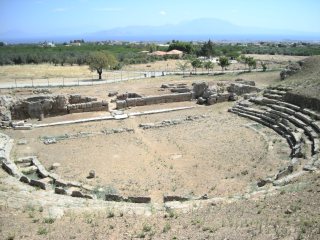
At the other end of the site survive the traces of the ancient sanctuary of Aphrodite, which occupied one of the highest points of the acropolis of Corinth. Lower down, the fountain of Upper Peirene★, laid out as early as the classical period in a natural cavity, provided a precious water reserve for the citadel. The presence of springs and numerous cisterns partly explains how a population could resist for a long time behind the walls.
From the Greeks to the Ottomans: twenty centuries of fortifications
The first major fortifications date back to the 7th-6th centuries BC and were strengthened in the classical and Macedonian periods. After the destruction of Corinth by Rome in 146 BC, the defences were restored when Julius Caesar refounded the city as a Roman colony in 44 BC. Acrocorinth then retained a major strategic role under the Byzantine Empire, which reinforced its walls on several occasions.
After the Fourth Crusade, the citadel became one of the great strongholds of the Frankish Principality of Achaea. The Villehardouin strengthened its defences in the 13th century, then further works were carried out under Angevin rule. In the 14th century, it passed to the Florentine Acciaiuoli, before returning in 1395 to the Byzantine despot of Mistra, Theodore Palaiologos. The Knights Hospitaller of Rhodes occupied it briefly between 1400 and 1404, then it remained with the Palaiologoi until the Ottoman conquest of 1458.
The Ottomans profoundly transformed the interior and maintained a large population there. The Venetians in turn took the stronghold in 1687 before losing it in 1715. After several sieges during the Greek War of Independence, Acrocorinth passed definitively under Greek control in 1823.
Visiting Acrocorinth
Discovering the site relies as much on the remains as on its exceptional setting. The ascent through the three gates, the long stretches of ramparts, the towers and the scattered ruins give a particularly clear reading of the different phases of fortification. The upper sections also offer vast panoramas over the Isthmus of Corinth, the two gulfs and the mountains of the Peloponnese. The extent of the site and its terrain require more time than a simple castle visit: you need to walk the different summits to truly understand the organisation of the fortress.
Map and route
In the city of Corinth
Nearby places to stay
On the same theme