Sicyon
Sicyon, near Kiato, was a powerful city and rival of Corinth, famous for its school of sculptors and painters. Its archaeological site preserves a vast Hellenistic theatre, an agora with its bouleuterion, and a museum housed in Roman baths.
Set on a plateau overlooking the coastal plain and the Gulf of Corinth, a few kilometres from Kiato, Sicyon (Sikyona) was one of the great cities of the northern Peloponnese. Today close to the village of Vasiliko, its vast archaeological site offers a walk among ancient remains, olive groves and panoramic views over the gulf. Less visited than Corinth or Nemea, it is well worth a stop for its theatre and small museum.
A powerful city and a great artistic centre
Governed in the 7th and 6th centuries BC by the dynasty of the Orthagorids, Sicyon rivalled its neighbour Corinth. It was above all renowned for its schools of painting and sculpture: the sculptor Lysippos, famous in particular for his portraits of Alexander the Great, and the painter Pausias developed their art there.
In 303 BC, Demetrios Poliorcetes had the city moved from the plain to this plateau, which was easier to defend. It is mainly this Hellenistic city, transformed in Roman times, whose remains can be visited. In 251 BC, Aratos of Sicyon overthrew the local tyrant and brought the city into the Achaean League, of which he became one of the principal leaders.
The theatre and the monuments of the agora
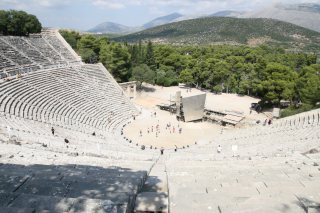
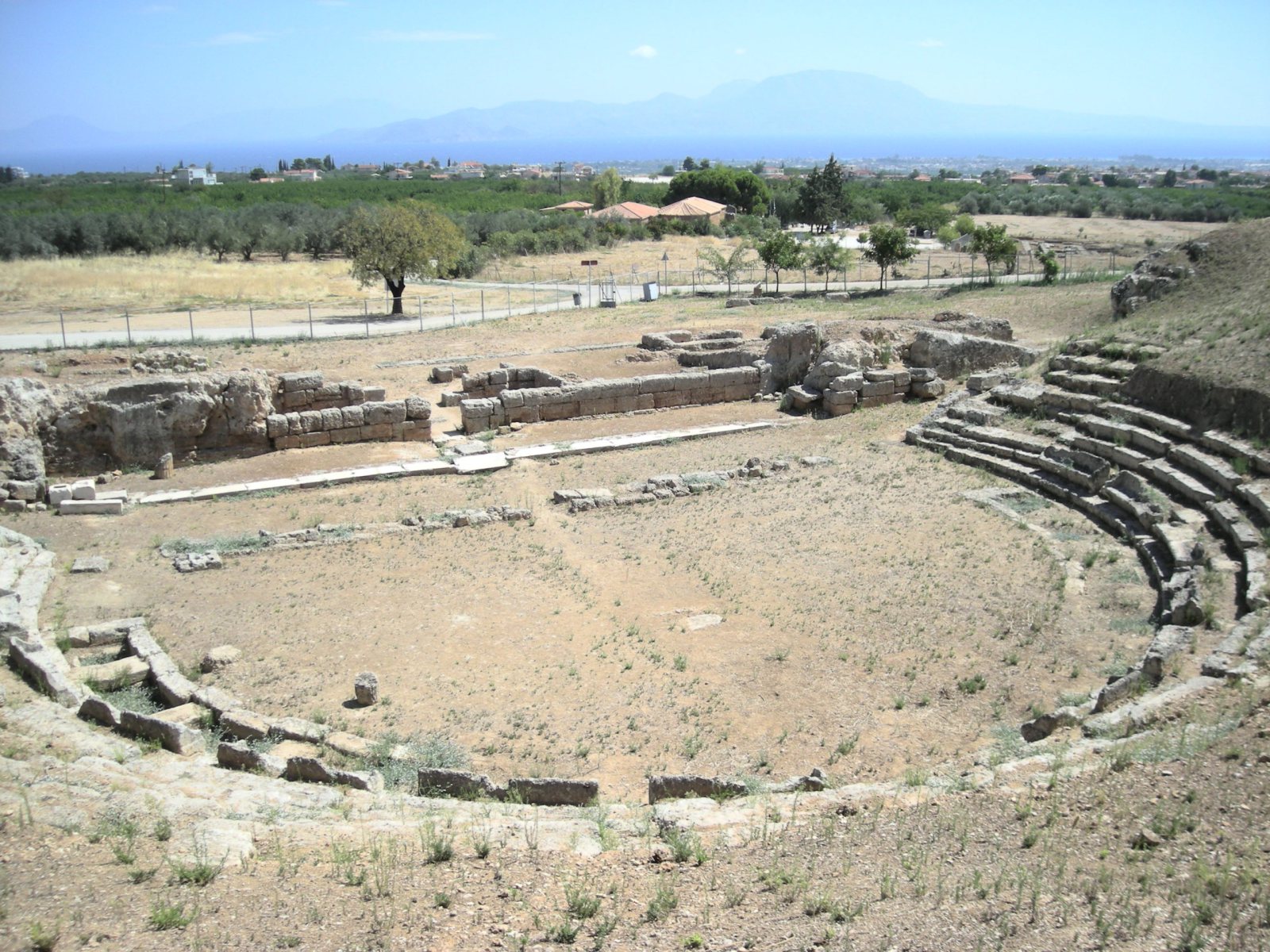
Theatre of Sicyon (Public domain, via Wikimedia Commons)
The most spectacular monument is the Hellenistic theatre ★★, laid out at the end of the 4th century BC on the natural slope of the hill. Its immense seating area, about 125 metres in diameter, combines seats cut into the rock and stone constructions. Two vaulted passages, preserved on either side, allowed spectators to reach the upper rows. The stage building was remodelled under the Romans.
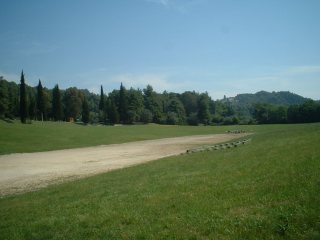
Below lies the agora, the heart of civic life, where the foundations remain of an ancient temple, later turned into a basilica in the early Christian period, of a long stoa and of the bouleuterion, the city council hall. The gymnasium-palaestra extends over two terraces linked by stairways, with the remains of two monumental fountains. To the west of the theatre, the line of the ancient stadium can still be made out in the terrain, although it has not been fully excavated.
The archaeological museum of Sicyon
Housed in part of a restored Roman bath complex, the museum brings together sculptures, inscriptions, pottery and mosaics from Sicyon and its surroundings. Notable among them is a marble bust of Apollo, related to the style of Praxiteles, as well as objects illustrating daily life from antiquity to the early Christian period. Allow about one to two hours to explore the site and the museum, depending on your interest in the remains.
Map and route
Near Sicyon
Nearby places to stay
On the same theme