Nemea
Nemea is an ancient sanctuary dedicated to Zeus, in Corinthia, known for its Doric temple and its well-preserved stadium. It is also the legendary site of the first of the twelve labors of Heracles, the slaying of the Nemean lion.
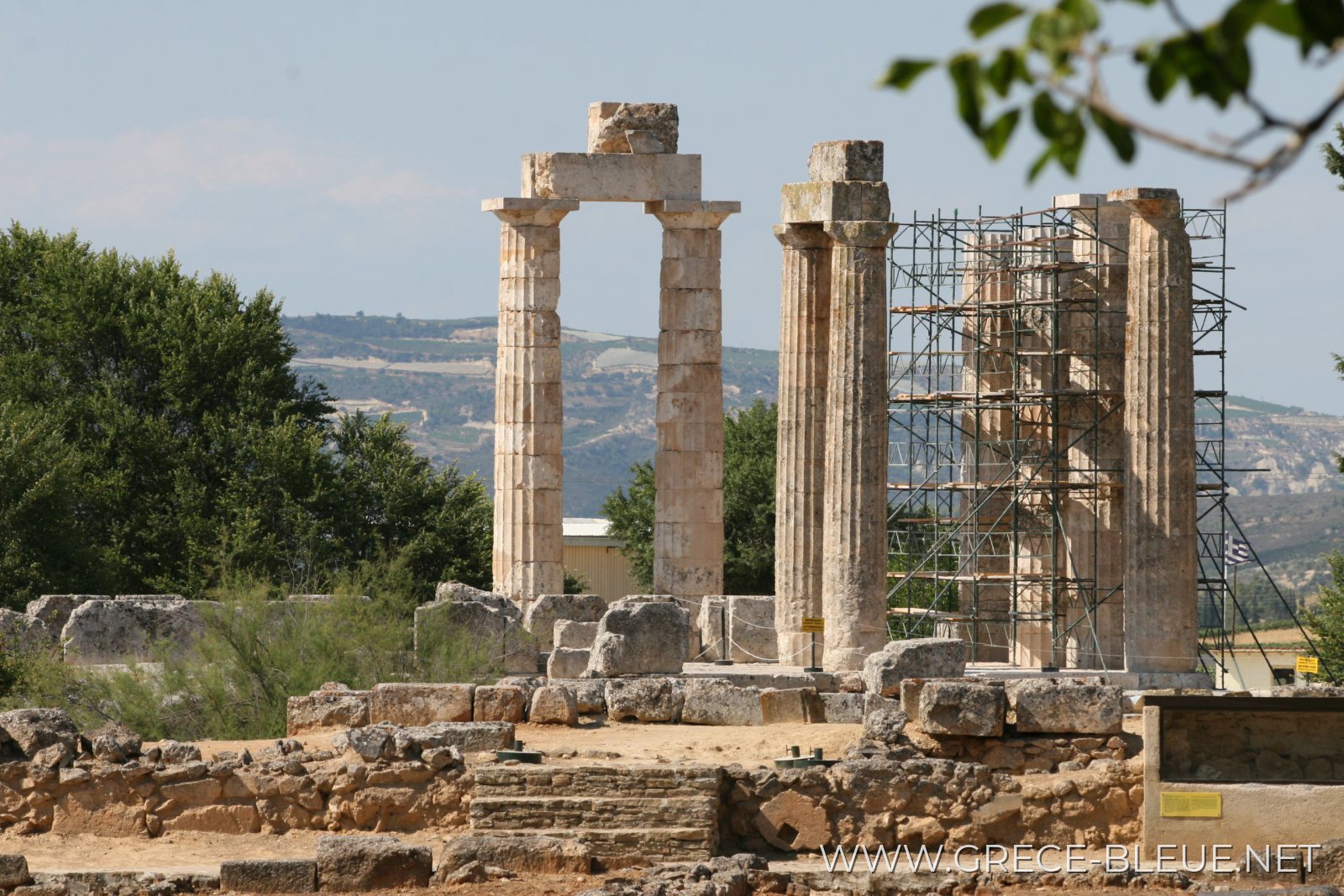
Nemea, sanctuary of Zeus and land of the Nemean Games
Nemea, in a valley of Corinthia in the north-eastern Peloponnese, houses one of the great sporting and religious sanctuaries of ancient Greece. Dedicated to Nemean Zeus, it hosted the Nemean Games, one of the four great Panhellenic competitions alongside those of Olympia, Delphi and the Isthmus of Corinth. The site, today surrounded by hills, olive groves and vineyards, combines the remains of the sanctuary, an archaeological museum and a remarkable ancient stadium.
The sanctuary of Zeus and the ancient stadium
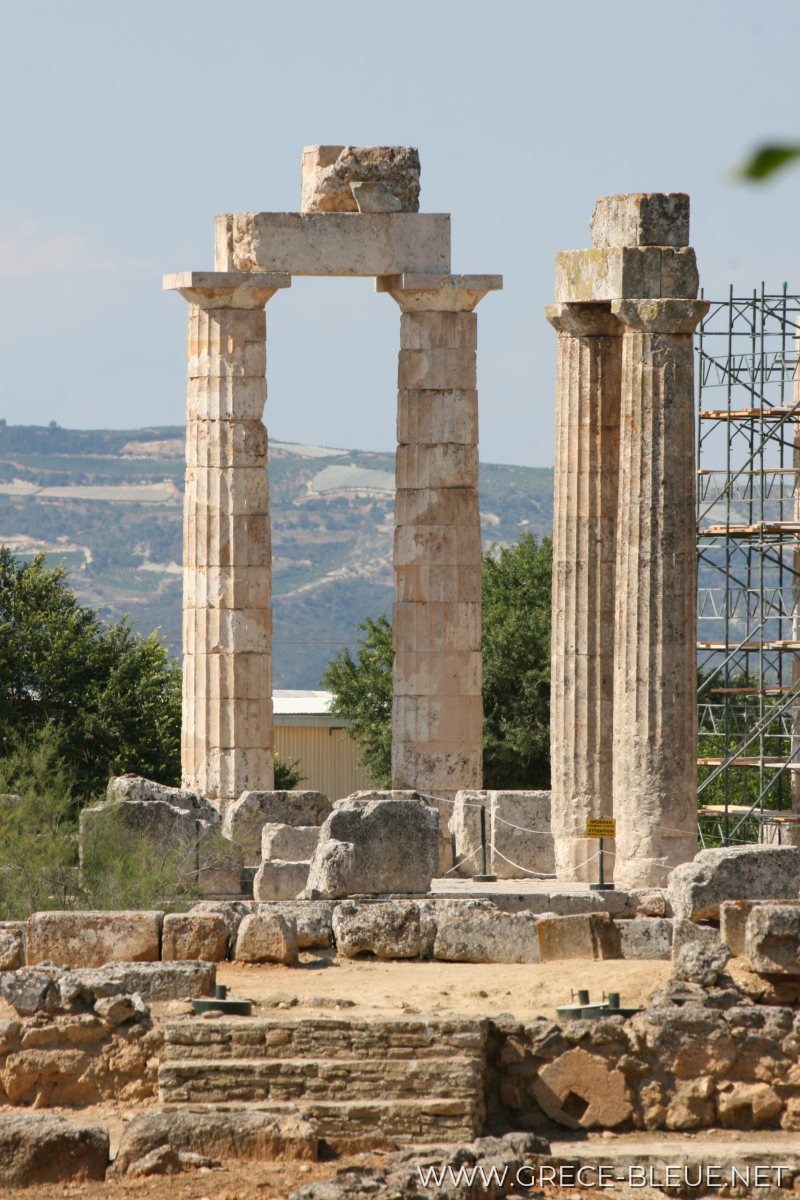
Temple of Zeus, Nemea
The main monument is the temple of Zeus★★, built around 330 BC. Several of its tall Doric columns have remained standing or were re-erected during modern restoration work. Around the temple remain traces of the altar, a sacred cypress grove, pavilions intended for delegations, baths, a xenon welcoming visitors and a hero shrine. The excavations conducted from the 1970s by the University of California at Berkeley, under the direction of Stephen G. Miller, profoundly renewed the knowledge and presentation of the site.
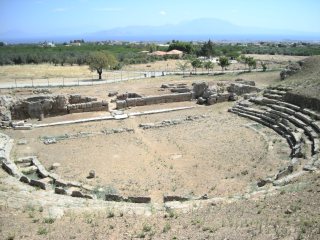
A few hundred metres away is the stadium of Nemea★★, laid out in the 4th century BC. The visiting route notably passes through the ancient apodyterion, where athletes prepared, then through the narrow vaulted tunnel that led to the track. Graffiti carved into its walls by ancient occupants are still visible. The stone starting line and the embankments that accommodated spectators make it fairly easy to reconstruct the organisation of the competitions.
Nemea is also the territory of the lion of Heracles. According to mythology, the hero accomplished there the first of his twelve labors by confronting the terrible Nemean lion, whose skin could not be pierced by weapons. After strangling it, Heracles donned its remains: the lion's skin and its head turned into a hood thereafter became his most recognisable attributes in Greek art.
The archaeological museum, housed within the site, gathers objects that help understand the sanctuary, the competitions and the ancient occupation of the region. The full ticket currently gives access to the museum, the sanctuary and the stadium. The visit thus forms a relatively compact ensemble, but rich enough to usefully complement the great ancient sites located between Corinth and the Argolid.
Since 1996, the Society for the Revival of the Nemean Games has also organised competitions in the ancient stadium, in principle on a four-year cycle. Participants run barefoot, dressed in a tunic, with no pursuit of records or medals, and use the same entrance tunnel as the ancient athletes. The eighth modern edition was held in 2024.
Finally, Nemea is today inseparable from its vineyard, one of the most renowned in Greece. Many estates can be visited in the valley and on the surrounding hills, mainly devoted to Agiorgitiko, the emblematic grape variety of the Nemea PDO used in particular to produce red wines.
Map and route
Near Nemea
Nearby places to stay
On the same theme