Corinth Canal and Isthmia
The Corinth Canal dramatically cuts through the isthmus that links the Peloponnese to mainland Greece. Dug at the end of the 19th century, it connects the Gulf of Corinth to the Saronic Gulf between impressive rock walls. The site also reveals the remains of the ancient Diolkos and more than two millennia of projects aimed at crossing the isthmus. Nearby, the sanctuary of Isthmia, home of the Isthmian Games, completes the visit.
Corinth Canal, the spectacular cutting of the Isthmus
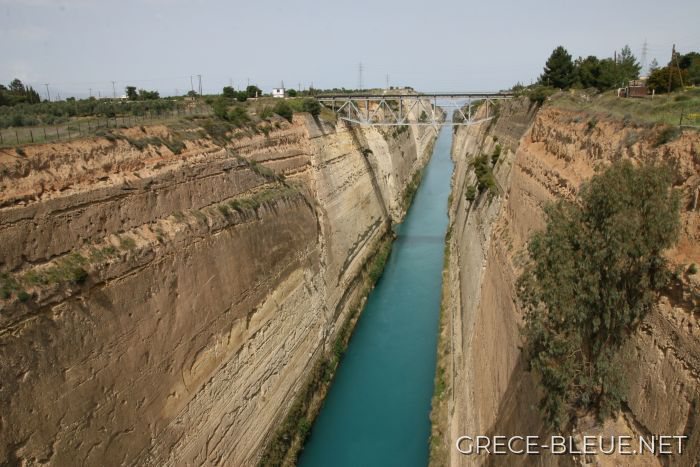
The Corinth Canal runs in a straight line across the isthmus that once naturally linked the Peloponnese to mainland Greece. Nearly 6.3 km long, it connects the Gulf of Corinth, open to the Ionian Sea, with the Saronic Gulf and the Aegean Sea. Its narrow width, about 25 metres at the surface, contrasts with its impressive rock walls, which rise in places to 79 metres above the water.
Seeing the Corinth Canal
Corinth Canal
The sight is particularly striking from the bridges★★ that span the canal: the eye plunges almost vertically towards the narrow ribbon of water hemmed in between the artificial cliffs. The passage of a ship gives a better sense of the unusual proportions of the structure, too narrow today for the largest modern vessels. At both ends of the canal there are also two curious submersible causeways, which sink beneath the water to let boats pass.
Near the western entrance, portions of the Diolkos★ survive, an ingenious ancient predecessor of the canal. From the 6th century BC, this paved trackway allowed ships or their cargoes to be transported from one shore of the isthmus to the other on carts guided by grooves still visible on some sections. Sailors thus avoided the long and dangerous detour around the Peloponnese.
A project more than two millennia old
The idea of cutting directly through the isthmus also dates back to Antiquity. Several rulers considered it, but the most spectacular attempt was that of Nero in 67 AD: the emperor personally inaugurated the works, according to tradition with a golden pickaxe, and several thousand prisoners were employed in the digging. The project was abandoned shortly after his death.
It was not until the 19th century that the project came to fruition. Work began in 1882, with the participation of engineers and capital from several European countries, and then encountered major financial difficulties. The canal was finally inaugurated in 1893. It considerably shortened certain sea routes around the Peloponnese and remains today one of Greece's most spectacular engineering works.
Isthmia, the sanctuary of Poseidon
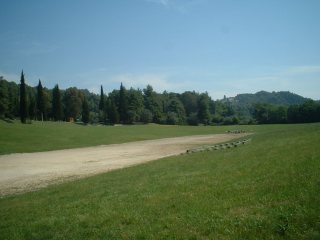
About two kilometres south of the canal, Isthmia was one of the four great panhellenic sanctuaries. Dedicated to Poseidon, from 581 BC it hosted the Isthmian Games every two years, with races, equestrian competitions and musical events.
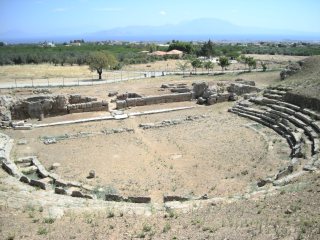
You can see the remains of the temple of Poseidon, the stadium, the theatre and Roman baths, and a museum displays the sanctuary's artefacts. The site also preserves sections of the Hexamilion, a fortified wall six miles long (about 7 km) that barred the isthmus in Late Antiquity, and whose construction reused stones from the sanctuary.
Access
By car from Athens, follow the A8/E94 motorway towards Corinth, then take the exit for Loutraki / Isthmia / Corinth Canal. From Corinth, the canal is a few minutes away by road towards Isthmia. To see the canal from above, the area around the Old Corinth Canal Bridge is one of the most convenient viewpoints.
At the western end, you can also reach the Diolkos, Poseidonos 76, Posidonia 201 00, to see the remains of the ancient haulage track.
Map and route
In the city of Corinth
Nearby places to stay
On the same theme