Arcadia
Arcadia, in the heart of the Peloponnese, is a region of mountains, forests and stone villages, long kept away from the main coastal routes.
It combines the landscapes of Mainalo and the Lousios Gorge with important ancient sites such as Mantinea, Tegea and Lykosoura.
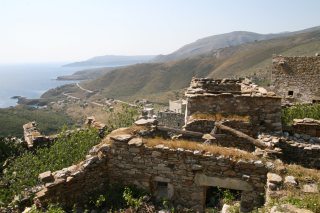
To the east, Kynouria opens Arcadia onto the sea around Leonidio, among cliffs, monasteries and Tsakonian traditions.
Arcadia, mountains, villages and ancient cities in the heart of the Peloponnese
In the centre of the Peloponnese, Arcadia is a vast region of mountains, high plateaus and steep valleys, long more isolated than the neighbouring coastal territories. Its landscape is dominated to the west by Mainalo and to the east by Parnonas, amid fir forests, stone villages and grazing lands. Arcadia also has a maritime frontage in Kynouria, facing the Myrtoan Sea.
In antiquity, this mountainous land was regarded as one of the oldest cradles of the Greek world and was particularly associated with the god Pan. Much later, "Arcadia" became in European culture the idealised image of a pastoral country living in harmony with nature, a vision that contrasts with the often turbulent history of its cities.
The region is therefore distinguished not by its monuments, but by the diversity of its territories: villages of Mainalo, the Lousios Gorge, sanctuaries and ancient cities, sacred mountains and Tsakonian villages of Kynouria. Dimitsana and the Lousios, Mantineia and Tegea, Mount Lykaio and Lykosoura, then Leonidio.
Dimitsana, Mainalo and the Lousios Gorge
The mountainous part around Mainalo is today one of the region's main tourist attractions. Dimitsana, Stemnitsa and Vytina are among the best-known traditional villages of the Peloponnese, with their stone houses, old mansions and churches. Further south, Karytaina is dominated by the ruins of an important 13th-century Frankish fortress.
Between Dimitsana and Stemnitsa, the Lousios Gorge★ combines wild landscapes and religious heritage. Trails lead in particular to the monasteries of Philosophou and Timios Prodromos on the cliffs, as well as to the remains of ancient Gortys. In Dimitsana, the Open-Air Water Power Museum★ recalls the role of the mills, tanneries and gunpowder factories once powered by the waters of the Lousios.
The Menalon Trail, about 75 km long, links several villages and crosses forests, gorges and old mule tracks.
The Kapsia cave, near the Mantineia plateau, is another natural curiosity of this inland Arcadia.
Mantineia, Tegea and the sanctuaries of ancient Arcadia
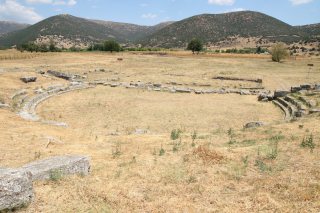
Around Tripoli, the main present-day town of Arcadia, several of the great cities of antiquity survive. Mantineia preserves important portions of its circuit wall, its agora, its theatre and several public buildings. The city occupied a strategic position on the great central plateau.
Further south, Tegea was, along with Mantineia, one of the most powerful cities of Arcadia. Its principal monument is the sanctuary of Athena Alea, whose great classical temple, rebuilt in the 4th century BC, was designed by the sculptor and architect Skopas.
North of Mantineia, ancient Orchomenos, set on a height overlooking the plain, preserves in particular a Hellenistic theatre, an agora and the remains of its fortifications.
Further south-west, Megalopolis was founded in the 4th century BC to become the political centre of the Arcadian League.
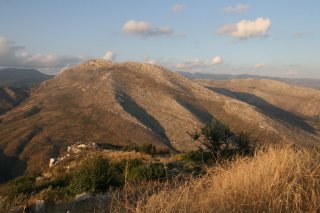
In the western mountains, Mount Lykaio was the sacred mountain of Zeus Lykaios and one of the oldest and most emblematic religious sites of the Arcadians. On its slopes survive the remains of the sanctuary and of the installations associated with the Lykaia games. Not far away, Lykosoura housed the sanctuary of Despoina, an important local deity, as well as a small archaeological museum. This ensemble is one of the best places to approach specifically Arcadian cults.
Kynouria, between Parnonas and the Myrtoan Sea
Eastern Arcadia offers a very different landscape. Around Astros and Paralio Astros, the mountains gradually reach the coast; the area preserves in particular a medieval castle, while nearby the Loukou Monastery and the remains of the vast Roman villa of Herodes Atticus form a particularly interesting heritage ensemble.
Further south, Leonidio is the main destination of southern Kynouria. Set beneath spectacular red cliffs, the small town preserves fine traditional mansions and is one of the main centres of Tsakonia, a territory where Tsakonian survives, a distinctive Greek language derived from the Doric dialect. The villages of Tyros, Prastos and Kastanitsa allow visitors to extend their discovery between sea and mountain.
Above Leonidio, the Elona Monastery, built beneath an immense rock face of Mount Parnon, is one of the most spectacular religious sites in this part of the Peloponnese. This coast, far less visited than neighbouring Argolida, combines small harbours, beaches, traditional villages and mountain landscapes.
Sources and information
Map and places in Arcadia
1 place and 3 zones in this territory.
 1
Archaeological site
Mantinea, Tegea and surroundings
At the heart of the Tripoli high plateau, Mantinea and Tegea were the two main cities of ancient Arcadia. Long-time rivals, someti…
 2
Territoire
In the heart of Gortynia: Dimitsana, Stemnitsa and the Lousios Gorge
3
Territoire
Leonidio and Tsakonia
Leonidio, at the foot of the Parnon cliffs, is the main gateway to Tsakonia, one of the most singular territories of the Peloponne…
 4
Territoire
Mount Lykaion and Lykosoura
Mount Lykaion, Lykosoura and Megalopolis thus offer an approach to three complementary aspects of ancient Arcadia: the sacred moun…
Nearby places to stay
Related areas
On the same theme