Sparta and the archaeological site
Sparta, in the heart of the Eurotas valley, was one of the most powerful cities of ancient Greece. Scattered remains survive of the great rival of Athens: the acropolis and a vast ancient theatre, the sanctuaries of Artemis Orthia, the Menelaion and Amyclae, complemented by the archaeological museum.
Sparta and its surroundings: in the footsteps of the great Lacedaemonian city
In the heart of the Eurotas valley, between the Taygetus and Parnon ranges, Sparta was one of the most powerful and most singular cities of ancient Greece. It is also known as Lacedaemon (Lakedaimon) to designate it together with its territory.
The small modern town, with about 18,000 inhabitants, now occupies part of the ancient city, in the middle of a vast olive plain dominated to the west by the peaks of Taygetus. Rebuilt in the 19th century according to a regular plan, it offers little monumental interest in itself, but constitutes a practical base for the sites of Sparta, Mistra★★ and the Eurotas valley?
The warrior city, rival of Athens
From the Archaic period, Sparta gradually dominated Laconia and then a large part of the Peloponnese. Its society rested on a very particular organization, with Spartan citizens subjected to a rigorous collective education, the agoge, the free populations of the Perioeci and the Helots, a dependent population largely responsible for agricultural work.
Spartan military power was particularly illustrated during the Persian Wars, to which the figure of King Leonidas remains attached, and then in the long rivalry with Athens. Sparta emerged victorious from the Peloponnesian War in 404 BC and briefly exercised domination over the Greek world. Its supremacy was however broken by Thebes at the Battle of Leuctra in 371 BC, before the city gradually lost its major political role.
The acropolis and the ancient theater of Sparta
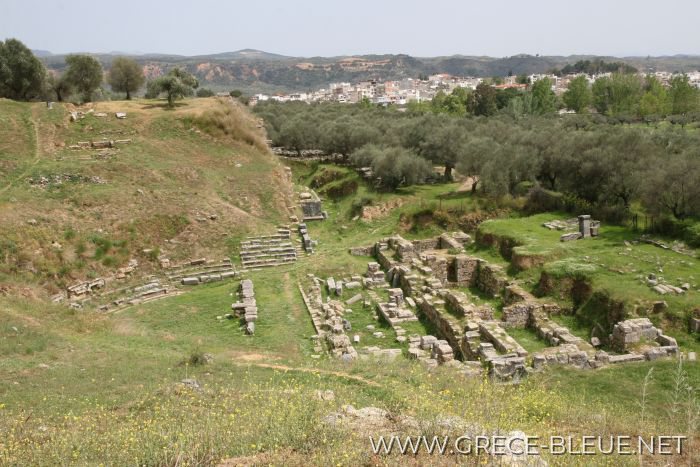
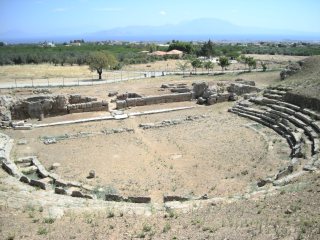
Ancient Greek theater of Sparta
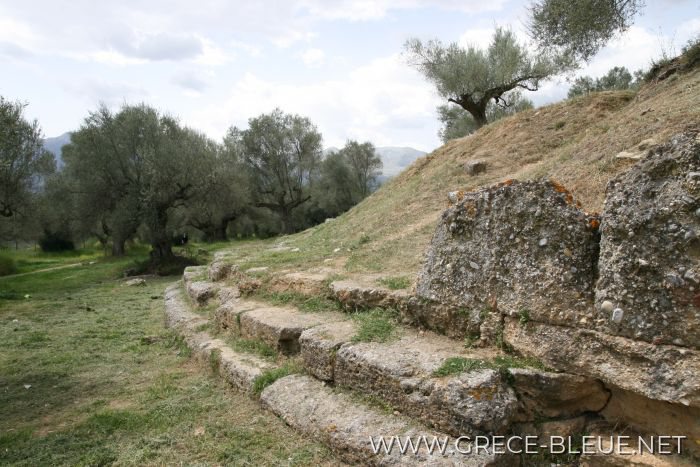
The main archaeological area is located just north of the modern town, on the acropolis hill. The remains there are relatively scattered among the olive trees, but they allow one to find several important monuments of ancient Sparta.
The most spectacular is the ancient theater★★, built at the transition between the Hellenistic and Roman periods, probably around 30-20 BC. Arranged in local white marble on the southern slope of the acropolis, it could accommodate about 16,000 to 17,000 spectators, which made it one of the largest theaters in the Greek world. It initially had a remarkable wooden movable stage, replaced in the time of Vespasian by a vast monumental stage building.
Above the theater was the sanctuary of Athena Chalkioikos, "Athena of the bronze house," one of the main cults of the city. Lower down remain the vestiges of a circular building of ancient origin as well as those of a large paleochristian basilica, recalling the continuity of occupation of the area after Antiquity.
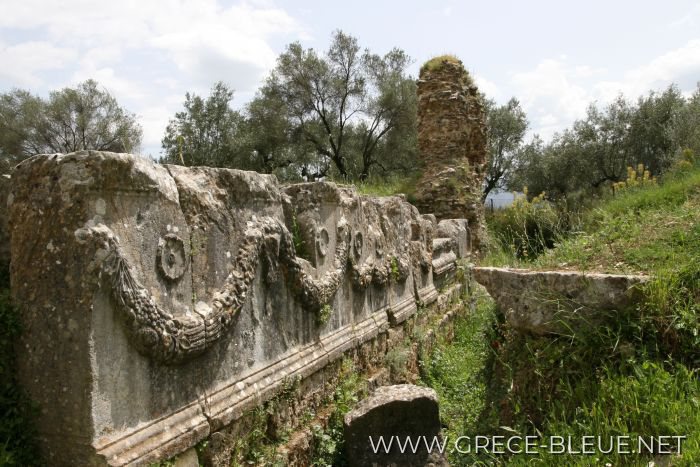
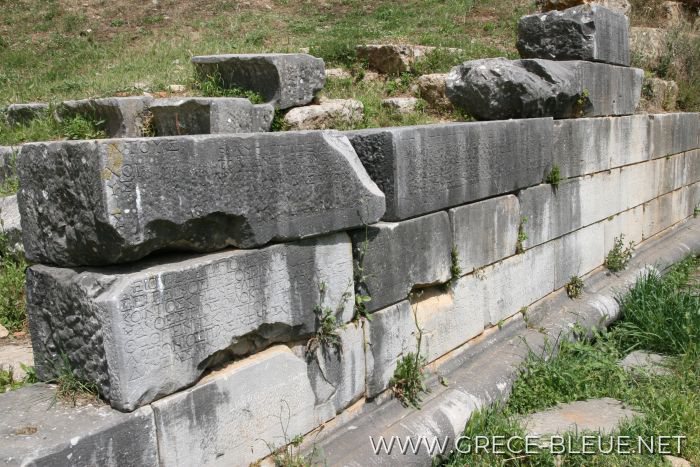
Not far from the acropolis is also the monument traditionally called the "tomb of Leonidas" or Leonidaion. The identification with the burial of the Spartan king remains debated, but this robust building of stone blocks is one of the most recognizable ancient monuments in the city.
Artemis Orthia, the Menelaion and Amyclae
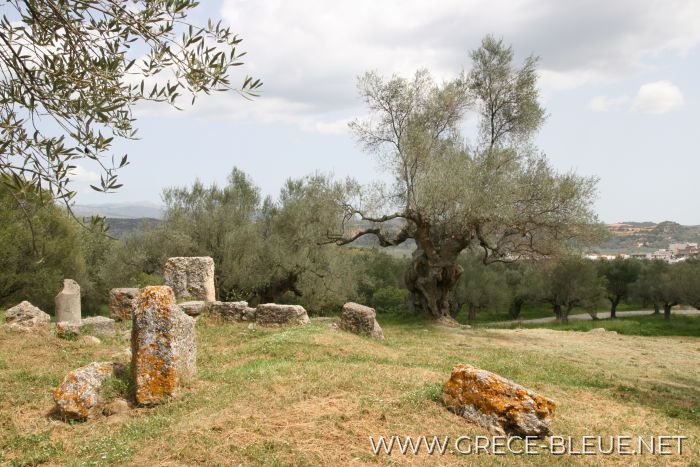
Other archaeological sites lie nearby, including, close to the Eurotas east of the town, the Sanctuary of Artemis Orthia★. It was one of the great religious centres of Sparta. The cult of Orthia, later identified with Artemis, goes back at least to the Geometric period (900-700 BC). The sanctuary was closely linked to the education of young Spartans; in Roman times, some of their ritual ordeals even became a spectacle watched by visitors.
On a hill east of the valley stands the Menelaion★, a sanctuary dedicated to Menelaus and Helen on a site occupied since Mycenaean times. The cult of the two heroes is attested there from the 8th century BC. The terraced monument visible today commands a vast panorama over the Eurotas, Sparta and the Taygetus.
South of Sparta, near Amyclae, the sanctuary of Apollo Amyklaios, of which a few stones remain, was among the most important places of worship of the Lacedaemonians. The Hyacinthia, a great religious festival associated with Apollo and the young Hyacinthus, was celebrated there. The sanctuary once housed the famous "Throne of Apollo" made by Bathycles of Magnesia around an ancient monumental statue of the god.
The Archaeological Museum and modern Sparta
The Archaeological Museum of Sparta★★ is an important complement to these scattered sites. Its collections bring together in particular objects from Artemis Orthia, Athena Chalkioikos, the Menelaion and Amyclae, as well as Roman mosaics. It also displays the famous archaic statue of a hoplite traditionally nicknamed "Leonidas", although it does not with certainty represent the king of Thermopylae.
The present town was laid out in the 19th century near the ancient remains and has a regular plan very different from the historic towns of the Peloponnese. Sparta is therefore appreciated less for a large continuous archaeological complex than as a territory to explore between acropolis, theatre, museum and sanctuaries scattered across the Eurotas valley. For anyone interested in Greek history, these remains allow the exceptional renown of Sparta to be set against the more discreet reality of its archaeological landscape.
Map and route
Near Sparta and the archaeological site
Nearby places to stay
On the same theme